
"My brain in three dimensions."
Professor Erin Graff Zivin (Spanish & Portuguese, Comparative Literature, USC) on the new Experimental Humanities Lab, vulnerability, exposure, and the exemplary Narcisa Hirsch.

When we are trained on and for the page, what does it mean to unfold whole other dimensions of our humanities practice? Over the last few years, comparative literature scholar Erin Graff Zivin has been living this project, with 96 year-old Argentinian feminist experimental filmmaker Narcisa Hirsch—who self-describes as una famosa cineasta desconocida—as a kind of guide. You can glimpse some of Hirsch’s gorgeous work, digitized by USC, here. And in the conversation below you can hear two feminist scholars sound out ways of doing humanities, in public, in the context of carefully crafted spaces, practices, and relationships, that make vulnerability (and thus newness) possible.
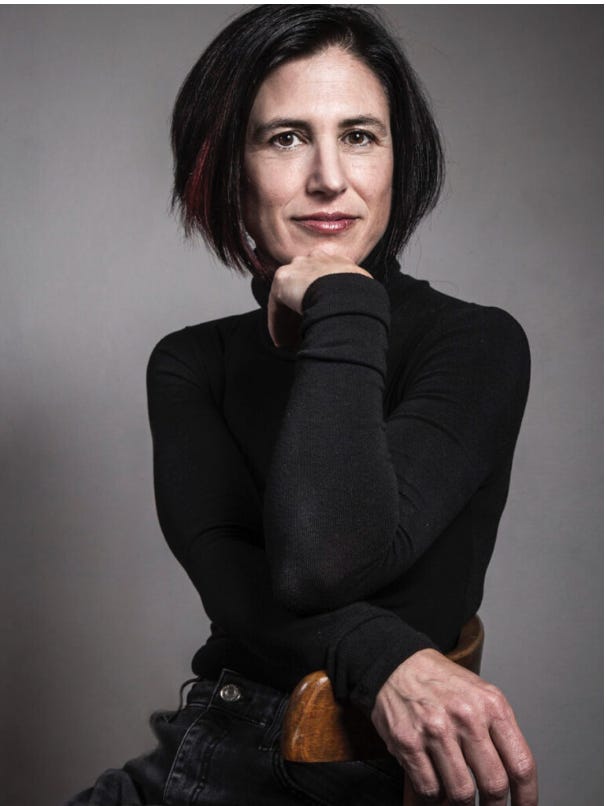
You were writing your books. And then all of a sudden, it felt like you were talking about film, and then there was this Experimental Humanities Lab at USC. . .
I was on a pretty traditional academic career trajectory: I’d published a few books, a bunch of articles, some edited volumes . . . I taught classes, delivered lectures, chaired two departments . . . all the things that we do. I’d just finished my third book, a book that allowed me to articulate a position on a number of issues, particularly in Latin American literary studies. It was all about looking at motifs of misunderstanding and opacity and error and blind spots in literature as a vehicle to insight.
After I finished the book, I started to look at the blind spots of my own work. I became impatient with the way that I was working, and without in any way wanting to take away from deeply theoretical scholarship, for which I continue to advocate. . . I guess I realized I’d grown a bit too comfortable. You know, it's like we're so scared for so long . . . your first public talk, or your first time walking into the classroom, or you publish something for the first time… these are all ways you are putting yourself out there. These experiences had ceased to be terrifying because I’d learned how to do them, more or less . . . so I decided that I wanted to take more risks, I wanted to expose myself to risk. The project that I'm working on now is about exposure–the ethical and political implications of being exposed–and I wanted to pursue this in many different forms.
The first project that felt like an experiment was the Women in Theory collective. I’d begun to grow increasingly impatient with theory spaces being male dominated, not because I had any issue with particular individuals but because I found myself trapped in a repeated situation in which I’d be the only woman (or maybe one of a very few women) on panels, at symposia, in edited volumes and special issues dedicated to theory. So I started the Women in Theory group with others, just as an experiment, and I think the fact that I was so explicitly anti-identitarian meant I didn't know how to formulate it. I still don't like the name, because what would it mean to designate it as a group or a practice for women without being essentialist? But it felt important to break out of, even just momentarily, a male-dominated space. (I described it as a moment, not a movement). So, it was maybe 2018 or 2019, and the ACLA conference was going to be held in Los Angeles. Knowing that a lot of theory people would be in town for that, I invited a group of women to USC the day before. I didn’t exactly know what to expect, particularly since those whom I’d invited worked in quite different areas, but I wanted to know what would happen if a bunch of women who work in areas of critical theory and philosophy were to sit in a room? And it was an incredible experience. Out of that came an international online colloquium on the question of women in theory, and a special issue of Diacritics dedicated to the topic. I think that there were things about it that succeeded, and things about it that failed–as with any true experiment.
I was also becoming increasingly fascinated by questions of formal experimentation, which is why the current project on exposure is centered on works of art that are translated, adapted, distorted, and reenacted across mediums. I went down to Argentina to do some archival research on one of the filmmakers that most excites me–Narcisa Hirsch, a pioneer of experimental film who just turned 96. There were a few films I could access online, but not too many. When I visited her home workshop, it turned out that she had a closet full of Super 8 and 16mm films that couldn't even be projected because of how precarious the medium is. And so I came back to USC and was able to figure out a way to digitize her life's work. The digitization project (a collaboration between the USC Digital Library, the USC Dornsife Experimental Humanities Lab, and the Filmoteca Narcisa Hirsch) led to an exhibition at the USC Fisher Museum of Art, screenings at 2220 Arts and Archives in LA, and most recently at MOMA in New York. So that was exciting… and scary!
So, when you say experimental humanities do you have a working definition for it?
The Experimental Humanities Lab aims to move beyond departmental and disciplinary divisions. Now, that's something that is talked about a lot in universities: interdisciplinary work is funded and celebrated, but it tends to be, for the most part, somewhat superficial. In other words, the common ground that we find . . . and common ground is incredibly important . . . ends up being sort of like the lowest common denominator, instead of something more profound or difficult. So I'm interested in setting up different kinds of scenarios between scholars, theorists, artists, practitioners—bringing people into a room together in a way that might be uncomfortable. Because when I talk about my work, hearing what a dance scholar and performer has to say about it might be really challenging, because it might show me that I've been, in fact, thinking about things in a completely… I don't want to say wrong way, but that I've been missing some crucial questions.
I was talking earlier in this series to a guy who's been doing some really deep collaborations with scientists lifting DNA from parchment –and he shared the way scientists frame collaboration that exposes them to novel approaches as just a natural, good thing. But reflecting on what you just said—approaching the discomfort of collaboration, as “Maybe I was thinking about it wrong”—I wonder what it would be like to trouble the fear that collaboration means discovering we’ve been doing it wrong. It sounds like that's what the Experimental Humanities Lab is about: holding space to do uncomfortable things together.
That’s a good way to put it. I describe the Lab as having a two-pronged mission. On the one hand, the Lab convenes theorists and practitioners in and of the experimental arts across different mediums. But it is also for people who are interested in experimenting with their own methodologies and practices: the Lab is itself an experiment that may fail. One of our working groups is called “‘(Rhy)pistemologies’: Thinking Through Rhythm.” It's based on an idea from Michael J. Love, a multidisciplinary tap dance, artist and scholar, and includes faculty, postdocs, and graduate students in the dance school, the music school, the film school, French and Italian, English, Comparative Literature, and Latin American and Iberian Cultures, all of whom are trying to push their work in new directions.
I remember when you described walking into the gallery space when it was set up for your first exhibition at the Fisher Museum. How did it feel? We're so used to the book as the zone of realization–how did it feel for you to for the first time to walk into an intellectual project realized in this . . . you're calling it transmedial space?
When I walked into the exhibition for the first time, I felt like I was walking through my brain in three dimensions. For artists that work in three-dimensional mediums—sculpture, say, or movement and kinesthetics, music and dance—that's perhaps an everyday experience. But for scholars, especially for literature scholars, we're so attached to the text on the page. Text played a part in the exhibition, but it was organized spatially and visually and sonically, and the sensation of moving through that space was exciting and strange.
There's that intimacy, which requires vulnerability, or exposure, which in some ways is a nightmare for scholars trained on a “mastery” model. Performing mastery of the archive defined doctoral education for so many of us. There have to be other modes of being in relation to the archive, right?
Speaking as someone who never felt herself to be an authority on anything, there were certain things that, as I said, I felt comfortable discussing. I've read the pages of Levinas’s Otherwise Than Being enough times and I'm still asking many questions about it, but they're different questions than the questions I may have asked, more naively, decades ago when I first read it.
But with this new work I'm absolutely putting myself in the position of beginner, amateur, or student, exposing myself, you know, but also naming it, and not idealizing that position either. Because–and this is something I am really learning in conversations with artists– it is about practice and habit, and refining a craft, but that does not necessarily lead to one day having it settled and under one's belt, finished and complete. It is also about continual renewal and (re)thinking in relation, which is another thing the mastery mode has endangered by narrowing us down to a certain kind of scholarly output.
You’ve had good support from your Dean and your College to do this work. There are people who are very worried that if they do this work they won't get a job. They won't get tenure. They won't get the next thing. What would you say to them?
I'm glad you asked that question because as I've been making changes in my own professional life, I've noticed that I've been mentoring Ph.D. students differently. I used to be much more conservative and say, focus on checking all the boxes, finishing your dissertation, the book, and then when you get tenure, you do what you want. I stopped giving that advice. I'm still making sure that the dissertations are being written, but many of my students have parallel projects, whether they're curatorial or creative, translation or editorial projects… wonderfully original experimental work. And I'm now very affirmatively encouraging them to do all of this work, and they're getting attention for it.
There is a model of public humanities–one holds forth with their knowledge in public. Right? You show up on a documentary, somebody interviews you, you know things; you give a lecture that people are invited to, and maybe attend. That's fine. But what I've heard you talk about is the idea of convening welcoming spaces where people can engage and experience and reflect on the human. And that's a big pivot, you know. That's a big pivot. I don't know that there has been a clear articulation of public humanities in that way. It's latent in a lot of people's work right now. How would you characterize the benefits of this holding space approach?
Perhaps I should clarify what I see as the limitations of a certain discourse on public humanities: the version that characterizes humanities scholarship as valuable only insofar as it is useful in some concrete, quantifiable, or identifiable way. I think that the humanities and the arts have a great deal to contribute and potential to transform our world, even through what might be perceived as, say, uselessness or irresponsibility. I guess I would want to emphasize that it's not just a question of–as you said–“I have this knowledge. I'm going to go to a different (more “public”) place to present that knowledge.” Rather, the knowledge itself is transformed in the coming and going, the leaving campus, or bringing non-academics onto campus. That movement, that displacement, shakes or opens up something . . . . perhaps it can be understood as exposure or even vulnerability. And that… that's when the unexpected might just happen.